


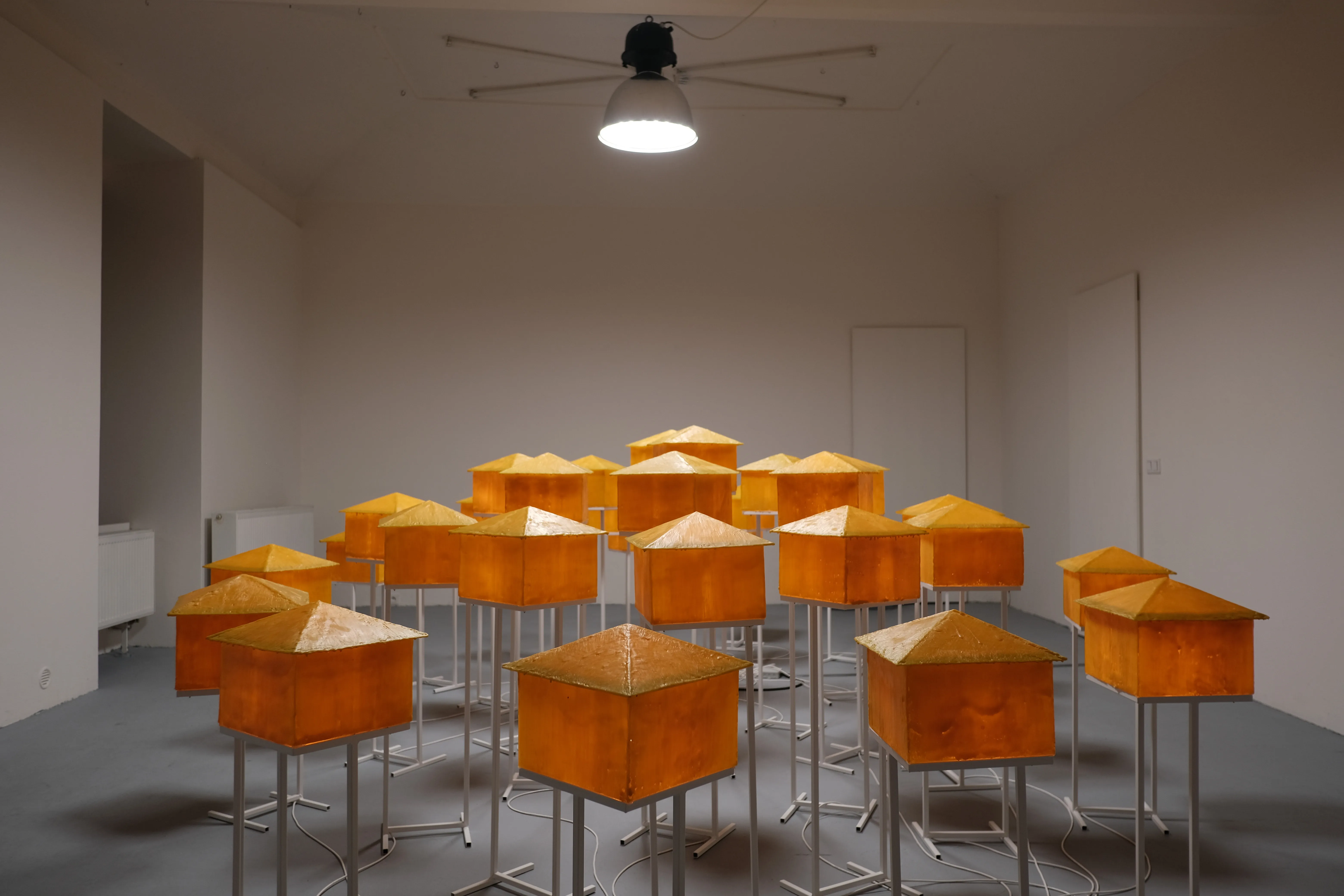

Location: VI PER Gallery, Prague, Czech Republic
Year: 2025
Status: Installation
The fading of fireflies across much of the world has become a quiet emblem of environmental decline. Once a familiar presence on summer nights, their glow marked the balance between natural rhythms and human habitation. Today, that soft bioluminescent pulse grows increasingly rare, dimmed by a convergence of ecological pressures—habitat loss, pesticide use, and above all, the expanding veil of artificial light.
Fireflies depend on delicate environmental cues to thrive. Their courtship rituals, conducted through rhythmic flashes of light, require darkness and clean, humid habitats. Urbanization and industrial agriculture have eroded both. Wetlands and meadows where larvae once matured in damp soil are drained, paved, or sprayed with chemicals. The insects’ life cycles—synchronized with temperature, soil moisture, and vegetation—are disrupted by the fragmentation of landscapes into fields, roads, and suburban lawns.
Light pollution compounds this decline with an almost invisible violence. The constant glare of streetlights, billboards, and residential lighting obscures the signals fireflies use to find one another, disorienting them and reducing reproductive success. What to humans appears as harmless brightness becomes, for these insects, an impenetrable fog of noise. In cities and villages alike, the artificial extension of day into night has silenced one of nature’s most delicate conversations.
Climate change adds further uncertainty. Warmer winters and altered rainfall patterns disturb hibernation cycles and reduce the availability of prey. The combined result is a slow vanishing—difficult to quantify, yet deeply perceptible. The fading of fireflies is not only an ecological loss but also a cultural one, erasing a sensory link between people and the living landscape. Their disappearance reminds us how thoroughly light, noise, and speed have replaced the quiet darkness that once allowed life itself to shimmer.
-
The fading of Georgian traditional architecture reflects the disintegration of a way of life once deeply rooted in place, material, and community. For centuries, Georgia’s vernacular architecture evolved not as aesthetic expression, but as a reflection of subsistence, climate, and social patterns. Stone and timber dwellings, shaded courtyards, and shared balconies embodied the rhythms of agricultural labor and communal living. These structures were not designed by architects, but by generations who understood how to build in dialogue with the landscape and with each other.
Industrialization during the Soviet period severed this connection. Centralized planning and rapid urban growth replaced traditional village life with standardized housing blocks and industrial settlements. Architecture ceased to grow from local knowledge and instead served the demands of production. The collective farm and the factory town became new architectural models, displacing the regionally distinctive forms that had defined the Georgian countryside.
The damage continued after independence, when extractive industries expanded into rural areas with little regulation. Mining companies reshaped valleys and riverbeds, eroding not only the land but also the cultural fabric tied to it. Entire villages were emptied or rendered uninhabitable, their houses collapsing into silence. The once self-sufficient relationship between people, land, and construction materials was replaced by dependence on imported goods and prefabricated structures.
As rural populations dwindled, so too did the craftsmen who had sustained these traditions. Carpenters, masons, and builders, once central to communal identity, found their knowledge devalued in an economy that no longer required it. Without the daily practice of maintenance and renewal, vernacular architecture began to decay—not as isolated buildings, but as an entire system of living. The result is a landscape of fragments: the remnants of a cultural order displaced by the machinery of industrial progress.
-